


Understanding what MDR is starts with the acronym itself, which stands for Managed Detection and Response. In practice, it is an outsourced cybersecurity service that monitors your environment, identifies suspicious behavior, and takes action to respond to threats.
Ransomware attacks, credential compromise, and lateral movement by attackers can happen at any time, including outside of business hours. It is precisely during these periods that many companies have fewer resources available to track security events and act in the face of a threat.
MDR addresses this scenario by combining continuous monitoring, threat detection, and incident response.
For mid-sized companies that do not have a dedicated security team or cannot maintain continuous monitoring, this service can expand their ability to identify and respond to incidents.
The longer a threat remains unidentified, the greater its potential impact on your environment. That is why understanding how MDR works, what it monitors, and in which situations it makes sense to hire it is essential to evaluate whether this model meets your company's needs.
That is what we will explain throughout this article. Read on!
Managed Detection and Response (MDR) is a service that monitors a company's networks, devices, and servers 24/7. It combines security technologies and expert teams to identify, investigate, and respond to cyber threats.
Unlike a solution that only generates alerts, MDR tracks security events and takes action on identified incidents.
In practice, this means keeping a security operation running 24 hours a day, 7 days a week, including during times when your internal IT team is off-duty.
Endpoint monitoring, identities, networks, cloud applications, and other environment components are some examples of what can be included in an MDR scope.
This combination is important because security tools generate large volumes of events.
Not every alert represents a real threat, yet malicious activity can go unnoticed when there is no one monitoring the signals, investigating the context, and taking the necessary steps.
That is why the main differentiator of MDR is the response. Instead of simply notifying you that something happened, the service can investigate the incident, determine its severity, isolate the affected device or account, and guide or execute remediation actions, depending on the service model.
MDR operates through a continuous four-stage cycle that runs simultaneously.
Each stage is supported by automation and validated by human analysts, eliminating both the false positives that waste your internal team's time and the real threats that would go undetected by automated tools alone.
See how:
MDR ingests telemetry data from all relevant sources in your environment: endpoints, servers, network, email, cloud environments, and SaaS applications like Microsoft 365 and Google Workspace.
This broad visibility is what allows for the identification of anomalous behavior patterns that an endpoint-only tool, such as an EDR, cannot detect.
The collected data is analyzed by a combination of artificial intelligence, behavioral rules, and continuously updated threat intelligence.
When something suspicious is identified, human analysts step in to classify the event: is it a false positive generated by a legitimate routine or a real threat that requires a response?
This human triage is what sets MDR apart from purely automated solutions, which often generate an excessive volume of alerts without proper prioritization.
Once a threat is confirmed, analysts investigate the scope of the incident: where it came from, which systems were affected, what lateral movement was detected, and what the potential impact is.
This step determines the appropriate response to what was found, avoiding both the underestimation of serious incidents and overreacting to low-risk events.
When a threat is confirmed, the team can execute or guide response actions, depending on the technology and policies defined for the environment.
Possibilities include:
· isolating devices;
· blocking or quarantining files;
· suspending users;
· other containment measures.
The goal is to prevent the incident from progressing while its origin and extent are being investigated.
In MDR services, therefore, detection is only one part of the process. The value lies in transforming detection into a coordinated response action.
Although MDR, EDR, XDR, and SOC often appear together in cybersecurity projects, they do not represent the same thing.
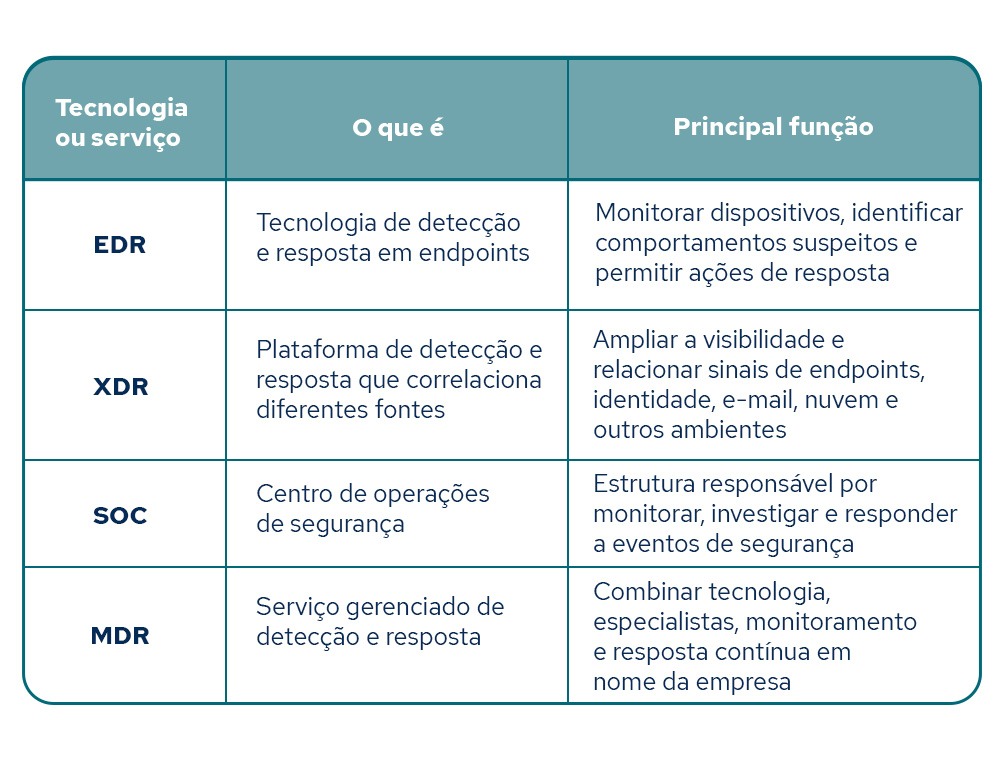
An EDR is a technology. In other words, it tracks endpoint activity and can generate alerts or execute specific automated actions.
Meanwhile, XDR expands this analysis by correlating signals from different layers.
The SOC, in turn, is an operational structure that can be internal or outsourced. A company can build its own SOC or use an external service to gain this capability.
The MDR is precisely a service model that can provide this specialized operation without requiring the company to build the entire structure in-house.
MDR can be especially relevant for organizations that need to expand their security capabilities without necessarily setting up a dedicated internal operation.
Key benefits include:
In the case of the LGPD, for example, the ANPD highlights the need to adopt technical and administrative measures capable of protecting personal data against unauthorized access and situations such as destruction, loss, alteration, or improper processing.
MDR does not, in itself, guarantee compliance with specific legislation. However, a structured detection, response, logging, and monitoring operation can be part of an organization's security and governance strategy.
There is a perception that continuous monitoring and response are resources primarily intended for large companies that can maintain internal SOCs, specialized teams, and professionals working in different shifts.
However, the need for monitoring does not disappear just because a company has a smaller IT team.
On the contrary, when only two or three people are responsible for the entire infrastructure, security, support, and corporate systems, it becomes riskier.
Especially when considering the need to track security alerts during the night, on weekends, and on holidays.
Furthermore, security requires expertise. Investigating a threat can involve behavioral analysis, event correlation, identifying indicators of compromise, and knowledge of techniques used by attackers.
This is where MDR can complement your internal structure.
A company may have antivirus, firewalls, EDR, and other tools, yet still struggle to keep up with everything happening in its environment.
This happens because having a security tool does not necessarily mean having a security operation.
An alert must be received, analyzed, contextualized, and, when necessary, turned into action.
MDR can take over continuous monitoring and investigation, while the internal team remains focused on infrastructure, systems, users, projects, and other strategic priorities.
In this way, the company does not necessarily have to choose between maintaining its IT team or outsourcing its security. The structures can work together.
Frayha Frayha specializes in the implementation and management of IT and security environments, connecting technologies, processes, and monitoring to the needs of each company.
That is why an MDR recommendation shouldn't start with the tool. The first step is to understand:
· which assets need to be protected;
· what risks exist;
· what resources are already available;
· what level of monitoring the environment requires.

MDR and MSSP (Managed Security Service Provider) are often confused because both involve outsourcing security.
However, they operate in fundamentally different ways, and the distinction matters a great deal when deciding what to hire. Here are the main points:
A traditional MSSP operates using predefined rules to generate alerts, functioning reactively within configured parameters.
Sophisticated threats that do not fit these rules go unnoticed.
MDR, on the other hand, combines rules with behavioral analysis and proactive threat hunting, actively searching for anomalous patterns even when no known rule has been violated.
This significantly expands the ability to detect advanced attacks that exploit legitimate behaviors.
MDR providers deliver structured reports on detected events, handled incidents, and the environment's security posture, with the level of detail required for internal audits, GDPR compliance requirements, and C-level communications.
This goes beyond the event logs typically provided by a traditional MSSP, offering context on what happened, the response taken, and the impact avoided.
The human element is the most important differentiator.
MDR analysts don't just verify alerts; they apply threat intelligence, recognize industry-specific attack patterns, understand the company's environment context, and make decisions that pure automation cannot.
An after-hours login alert could be an employee traveling or a compromised credential; only an analyst with context can quickly distinguish between the two.
This is the most concrete difference: an MSSP issues an alert and waits for the company's internal team to act.
An MDR provider, on the other hand, executes the response, blocking compromised access, isolating the affected device, or containing the attack's lateral movement while notifying the internal team of what was done.
In an ongoing ransomware attack, this difference can be what separates a quick containment from a total operational shutdown.
Microsoft Defender is one of the most robust endpoint detection and protection tools available for enterprise environments, especially for companies operating within the Microsoft 365 ecosystem.
It collects telemetry, identifies suspicious behavior, blocks known malicious files, and generates detailed alerts about what is happening on company devices.
However, Defender, like any detection tool, depends on someone to operate the alerts it generates.
In an environment without MDR, these alerts go to the internal IT team, which often lacks the time, expertise, or 24/7 availability to handle each one with the speed and depth that a real incident requires.
In fact, Environments with a high volume of alerts without proper triage tend to develop alert fatigue, a phenomenon where critical events are ignored because they get lost in the noise.
With MDR, Defender transforms from a passive tool into an active layer of defense: the provider's analysts monitor alerts in real time, investigate relevant events, discard false positives, and execute responses when necessary.
Defender provides the signal; MDR ensures that someone is always listening and taking action.
For mid-sized companies, for example, Frayha also integrates a proactive cybersecurity monitoring platform designed for SMBs and MSPs, which complements Defender's visibility by covering additional environment layers such as email, identity, and cloud configurations.
This combination, operated by Frayha's 24/7 MDR team, covers the most common attack vectors without requiring the company to maintain multiple separately managed security tools.
At Frayha, MDR is designed as part of a broader strategy for protecting the IT environment.
The strategy can integrate Microsoft Defender, a human team of experts, Acronis tools, and principles of Zero Trust, considering the devices, identities, applications, and data that are part of the operation.
In practice, this means combining technology and expert oversight to:
· continuously monitor security events;
· identify and prioritize threats;
· investigate suspicious behavior;
· reduce false positives;
· contain incidents when necessary;
· support remediation;
· generate visibility into the security posture;
· adapt controls to the company's context.
The expected result is not to eliminate every single risk, something no security solution can guarantee. The goal is to increase the ability to detect, investigate, and respond to incidents before they cause major impacts.
This approach also allows the internal IT team to stop carrying the responsibility for continuous monitoring alone, keeping their focus on projects, infrastructure, users, and business objectives.
Want to understand if MDR makes sense for your company's current structure?
👉Talk to Frayha and request a free assessment of your IT and security environment.
From this, it is possible to identify the main monitoring gaps and evaluate which technologies and strategies can be integrated into your operation.
No. Antivirus is a protection technology that seeks to identify and block malicious software and other threats. MDR is a service that combines security technologies with monitoring, investigation, and response performed by experts.
Therefore, antivirus and MDR can work in a complementary way within a security strategy.
It depends on the structure and needs of your environment. Microsoft Defender has advanced protection, detection, investigation, and response capabilities.
MDR adds an operational layer of specialized monitoring and response, which is especially relevant for companies that do not have a dedicated security team to track events continuously.
First, the event is analyzed and classified to determine if it represents a real threat. When an incident is confirmed, containment and remediation actions can be taken according to the technology used, environment policies, and the scope of the service.
Depending on the situation, the response may include isolating a device, quarantining a file, suspending a user, or other measures intended to stop the attack from continuing.
Traditional MSSP is primarily associated with the management and monitoring of security services and tools. MDR, on the other hand, has managed detection, investigation, and response as its core characteristic.
However, scopes vary between providers. Therefore, any comparison should consider what each service actually delivers, especially regarding 24/7 monitoring, investigation, response, and remediation.
Not necessarily. MDR can complement the internal team by taking on part of the security monitoring, investigation, and response, especially outside of business hours.
The internal team remains responsible for other IT fronts and can participate in the decisions and actions necessary during incidents, depending on the operating model defined with the provider.
Microsoft itself describes MDR services as a way to expand an organization's security capacity, rather than necessarily replacing its entire internal structure.

Learn the difference between data backup and recovery, understand RPO and RTO, and prepare your company to act when things go wrong.
Copilot, ChatGPT, Claude e Gemini já estão na sua empresa. Mas quem controla o que é compartilhado? Entenda tudo sobre governança de IA.
Do you know where the danger comes from? Discover the 8 cyber risks threatening your company and learn how to take action!

Schedule a conversation with our experts and discover how we can protect and boost your business, with no obligation.