


Ransomware is a type of malicious software that hijacks data and systems, encrypting everything it finds and requiring payment, generally in cryptocurrency, to return access.
What was seen a few years ago as a distant threat, restricted to large international corporations or technology news, has reached the daily lives of Brazilian companies with force and severe consequences. Now, managers wake up to discover that no system works, files display unknown extensions, and a ransom message fills the screen, with a deadline for payment. It's too late to act, and the damage has already begun.
Therefore, understanding what ransomware is, how it operates, and what to do to prevent it is, today, a responsibility of any business leader.
Read on and discover how to protect what your company took years to build.
The term comes from the combination of ransom, the English word for ransom, with malware, the generic name for malicious software. In practice, Ransomware is a program designed for infiltrate systems, encrypt files, and make the operation completely inaccessible Until the victim Pay for the unlock code, with no real guarantee that you will receive access back.
In addition, the process takes place in well-defined steps. First, the attacker obtains access to the environment, often through a phishing email, a compromised credential, or an uncorrected vulnerability in a system exposed to the internet.
Once inside, the malware moves laterally across the network, mapping servers, backups, and critical systems before activating encryption. This period of silent dormancy can last for days or weeks, making detection especially difficult.
Thus, once the encryption is activated, the operation comes to a standstill. Documents, databases, emails, ERP files, customer records, everything is inaccessible. The ransom message appears with an amount, a deadline and, increasingly, a second threat: if payment is not made, the stolen data will be published or sold.
And something alarming is that this model, called double extortion, has become standard among the most organized criminal groups, amplifying the financial and reputational impact of the attack.
Not only is Brazil a frequent target of ransomware, it is also one of the world's favorite targets. The latest data reveals an alarming scenario, especially for those who still believe that basic antivirus and simple passwords are sufficient to protect an operation.
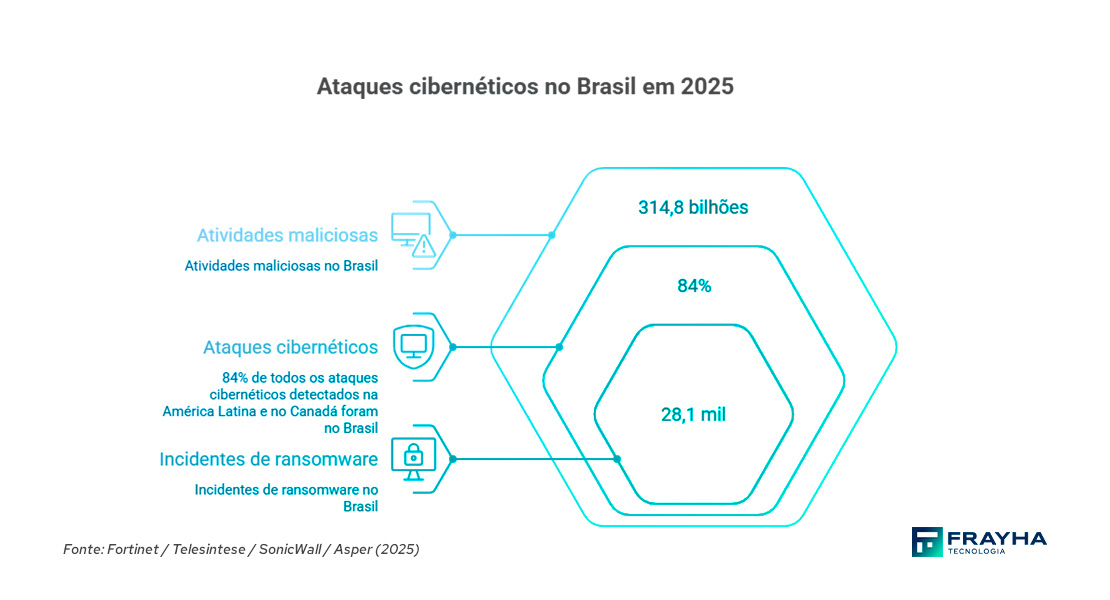
According to the report FortiGuard Labs by Fortinet, Brazil registered 314.8 billion malicious activities in the first half of 2025, concentrating 84% of all cyberattacks detected in Latin America and Canada in the period.
Among these activities, we identified 28.1 thousand ransomware incidents, with 98% of actions concentrated in the impact phase, that is, rapid, targeted attacks aimed at the immediate interruption of the operation.
On the other hand, the report of Acronis Cyber Threats, referring to the second half of 2025, positioned Brazil among the three countries with the highest volume of ransomware detections in the world, second only to the United States and India. The survey also points out 20% growth in attacks per user compared to the previous year and significant expansion of threats on collaboration platforms, such as Teams and SharePoint.
In February 2025, the country recorded an all-time record: more than 960 ransomware attacks in a single month, according to the report of SonicWall, a number that highlights the rapid pace at which criminal groups have intensified operations against Brazilian companies.
One of the most dangerous perceptions that managers carry is the idea that cyberattacks require highly trained hackers exploiting obscure system flaws.
However, the reality is more disturbing: most successful invasions start with simple, humane, and predictable paths.
Shall we meet them?
Fraudulent emails remain the most used gateway of entry. For example, an employee receives an apparently legitimate message from a bank, supplier, or even the company's own HR, clicks the link or opens the attachment and, without realizing it, installs the malware in the corporate environment.
Phishing has evolved significantly, with criminals using artificial intelligence to create highly personalized and convincing messages, increasing the success rate of campaigns.
Weak, reused, or passwords obtained in previous leaks are exploited to access VPNs, administration panels, and remote access tools like RDP.
Once with valid credentials in hand, the attacker operates as a legitimate user within the network, making detection difficult and buying time to map the environment before activating encryption.
Unupdated systems, legacy software, and network equipment with outdated firmware represent known and documented breaches that criminal groups systematically exploit.
According to the survey of ISH Technology, vulnerability exploitation grew 8.1% in 2025, with more than 40,000 flaws published throughout the year, each representing a window of opportunity for intruders.
When a company is hit by ransomware, the impact goes far beyond crashed systems.
That's because the consequences branch out by financial, operational, legal and reputational areas, often leaving marks that last much longer than the technical recovery time.
See:
· Operational shutdown: ERP, CRM, e-mail, and communication systems are inaccessible, interrupting sales, service, logistics, and production. Every hour of inactivity has a direct and measurable cost.
· Cost of redemption and recovery: The average global rescue demand reached 2.73 million dollars in 2025, according to Gridinsoft data. But even companies that choose not to pay face high costs of incident response, digital forensics, system reconstruction, and emergency training.
· Data exposure and leakage: with double extortion consolidated as a standard, criminals threaten to publish sensitive customer data, contracts, financial and strategic information if the ransom is not paid, creating an immediate legal and reputational liability.
· LGPD sanctions: an attack that results in the leak of personal data activates the notification obligations of the General Data Protection Law, which may result in fines of up to 2% of annual revenues, limited to R$ 50 million per violation, in addition to investigations by the ANPD.
· Damage to reputation: customers, partners, and suppliers lose trust in a company that has demonstrated vulnerability. In regulated sectors such as healthcare and finance, this damage may be even more structural.
Imagine a medium-sized legal firm that, confident in the antivirus installed on each machine and in the scheduled daily backup to a local server, believes it is protected.
On a Monday, when you turn on the computers, all files are encrypted, including the backup server, which was connected to the same network and was compromised along with the other systems. The antivirus didn't detect the ransomware because the variant was new, not yet catalogued in the subscription bases.
The backup existed but was inaccessible. Thus, the operation stopped for twelve days.
This scenario represents a misconception that is still very common: confuse the presence of basic security tools with the existence of a robust security posture.
Traditional antiviruses work based on known signatures, making them ineffective in the face of new or customized ransomware variants.
Additionally, backups stored on devices connected to the network are compromised along with the environment at the time of the attack.
The appropriate response to this risk involves two complementary fronts. The first is immutable backup, stored in an isolated, offline, or cloud environment with protection against modification, ensuring that there is always a full copy of the data that cannot be reached by ransomware.
The second is Disaster Recovery, a structured plan that defines not only where the data is, but how and how soon the operation will be re-established after an incident, with previously defined and tested RTOs and RPOs.
Thus, real security requires a layered approach: continuous environmental monitoring, identity and access management, network segmentation, real-time threat detection and response (EDR/XDR), and a clear governance policy that involves the entire organization, not just the IT team.
The question that all leaders should ask themselves is not whether their company can be the target of ransomware, the data shows that Brazil is already among the three most attacked countries in the world. The right question is whether your operation is prepared to resist, detect, and recover from an attack before it causes irreversible damage.
Frayha acts as a strategic partner in building and managing IT environments that are secure, resilient and in compliance with best market practices.
Specializing in cybersecurity, cloud infrastructure, Disaster Recovery, and Microsoft, Guardz, and MDR 24x7 solutions, the company offers an integrated approach that ranges from prevention to incident response, covering the gaps that antivirus and basic backups simply cannot close.
Whether implementing immutable backup, structuring a Disaster Recovery plan, or monitoring your environment in real time to detect suspicious behavior before ransomware is activated, Frayha provides the security that serious operations need, with cost predictability, defined SLAs, and support of those who deeply understand the Brazilian threat landscape.
Request a free diagnosis and discover where your operation's vulnerabilities lie before criminals find them.

Learn when to hire IT consulting, the difference between reactive support and strategic maintenance, and the criteria for choosing the right partner.
Antivírus comum não basta mais. Veja como unir antivírus, firewall e IA para proteger sua empresa de verdade. Leia!

Learn the importance of cloud backup because the provider doesn't guarantee everything. Understand the real risk and what to do about it. Read on!

Schedule a conversation with our experts and discover how we can protect and boost your business, with no obligation.