


With the decentralization of operations and the consolidation of hybrid work, understanding what an endpoint is became the first step for any manager seeking digital resilience.
In the past, security was limited to the walls of the office, however, today the company perimeter is wherever the employee is, whether in a cafe, at the airport or at home. In this sense, network endpoints are the new gateways for sophisticated cyber threats.
If you want to understand how to protect your infrastructure and ensure business continuity, continue reading this article and discover how to transform your digital defense.
In technical terms, an endpoint is any device that connects to a business network, serving as a data entry or exit point.
In this way, we are talking about notebooks, smartphones, tablets, servers, printers, and even smart Internet of Things (IoT) devices. In other words, if the equipment exchanges information with your server or with your cloud, it is an endpoint.
In the past, security focused on the office firewall, trying to create a kind of “fortress” where all data was internally protected. However, digital transformation and mobility forced a drastic change. This is because, in the current scenario, the employee uses the company's notebook on home Wi-Fi to access Google Workspace or Microsoft 365.
Imagine, for example, an IT coordinator who accesses sensitive data via cell phone while traveling; that smartphone is a critical endpoint that, if compromised, can serve as a bridge for an attacker to reach the entire structure of the organization.
Additionally, the importance of endpoint security lies in the fact that these devices are the preferred targets of hackers. Rather than trying to break down a robust firewall, criminals prefer to send a phishing email to a distracted collaborator. If the endpoint is not properly protected, a simple click can initiate a ransomware infection that spreads silently across the entire network, paralyzing the operation and causing incalculable financial losses.
Investing in a solid protection strategy for these devices has advantages that go far beyond simple virus prevention.
In other words, it's about ensuring that the company can grow in a sustainable way, without the constant fear of catastrophic interruption. By adopting advanced solutions, managers experience direct benefits such as:
· Full network visibility: know exactly which devices are connected and what is the update level of each one of them, eliminating blind spots in the infrastructure.
· Sensitive data protection: ensure that sensitive customer and company information is not leaked through lost, stolen, or hacked devices.
· Business continuity: dramatically reduce downtime by detecting and isolating threats before they access central servers.
· Compliance with the LGPD: meet legal data protection requirements, avoiding heavy fines and damage to the brand's reputation in the market.
· Optimization of IT resources: allow the technical team to focus on innovation instead of spending all day solving specific infections on user machines.

Modern endpoint security works as an intelligent and proactive ecosystem. Instead of just reacting to a known virus signature, current systems use artificial intelligence and behavioral analysis to identify suspicious activities.
In this sense, when a notebook begins to encrypt files in bulk in an atypical way, the protection software identifies this behavior as a possible ransomware attempt and blocks the process instantly. However, effective operation depends on a cloud-based architecture. The agents installed on the devices send real-time data to a centralized console.
This allows that, even if the employee is outside the company, security policies continue to be applied.
Thus, if a critical vulnerability is discovered in an operating system, the IT manager can trigger the update for all endpoints simultaneously, regardless of the geographical location of each one, ensuring that the window of opportunity for the attacker is closed quickly.
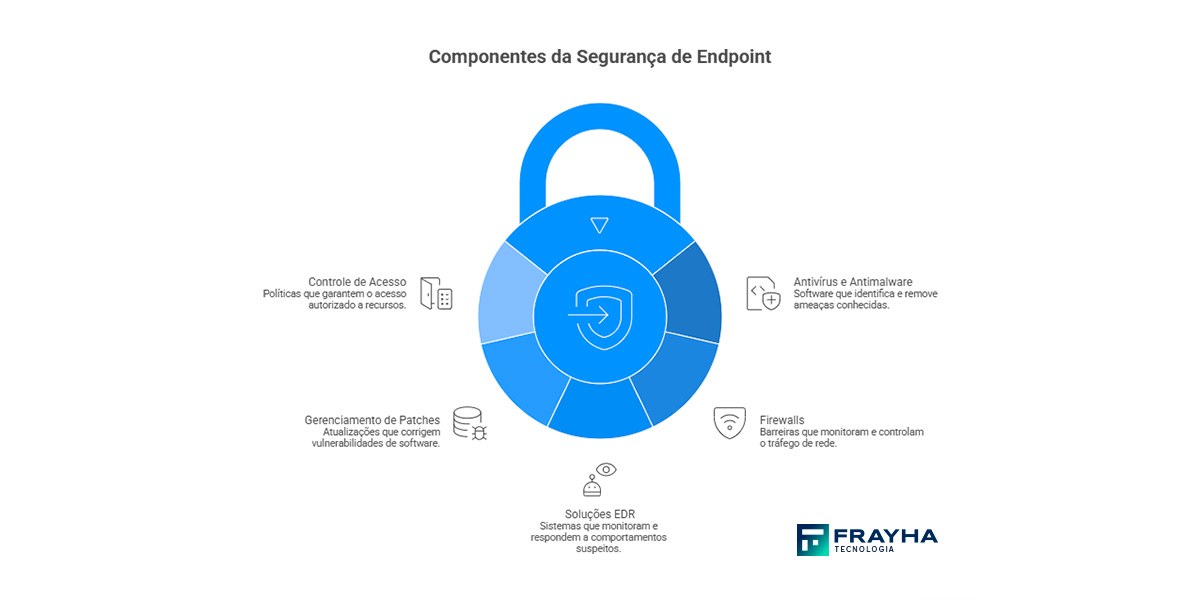
There are 5 main elements that constitute a larger endpoint-focused security system. The association between them makes the system more complete and efficient in safety.
They are:
· Access control;
· Patch management;
· EDR solutions;
· Antivirus and antimalware;
· Firewalls.
For a solution to be considered complete, it must integrate different layers of defense that work in harmony. Not limited to just an installed antivirus, because it is necessary to have tools that allow remote investigation and management.
Thus, the essential elements are:
O EDR (endpoint detection and response) is the evolution of traditional antivirus. In addition to blocking threats, it also records each event that occurred on the device so that the security team can understand how the threat tried to enter.
Already XDR (extended detection and response), like the one offered by Acronis, goes further, integrating data from endpoints, networks, and clouds for holistic protection. That's because modern security requires a correlated view of all attack vectors.
A Any endpoint's last line of defense is backup. However, we don't just talk about copying files.
Advanced solutions like those from Acronis integrate cyber protection with site-to-cloud backup. If a device is compromised or experiences a hardware failure, recovery needs to be quick and comprehensive.
In this way, disaster recovery ensures that the employee returns to production in minutes, minimizing the impact on productivity.
Centralized management is what allows scale. Thus, using a platform like Kaseya allows Frayha to proactively monitor the health of all customer endpoints.
O RMM enables the automation of repetitive tasks, hardware inventory, and immediate remote support. In other words, it is the tool that transforms reactive IT into strategic and preventive management.
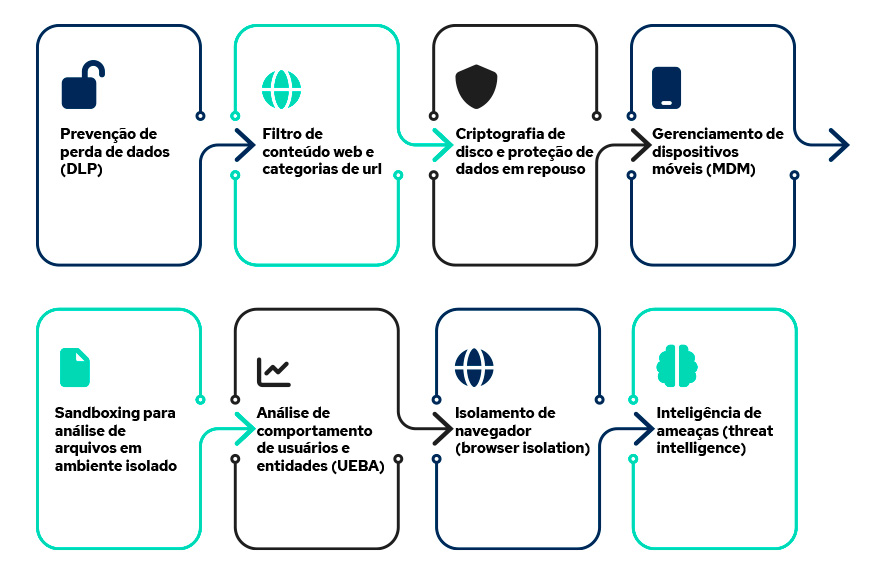
In addition to the components mentioned above, other points that deserve attention when talking about a comprehensive endpoint security system are:
· data loss prevention (DLP);
· web content filter and URL categories;
· disk encryption and data protection at rest;
· mobile device management (MDM);
· sandboxing for file analysis in an isolated environment;
· user and entity behavior analysis (UEBA);
· browser isolation;
· threat intelligence.
Many business owners still confuse these concepts, which can create a false sense of security. Did you know that having a state-of-the-art firewall doesn't protect your notebook if it gets infected via a flash drive or an external network?
Well, each tool plays a distinct role in defense.
The firewall acts as the network gatekeeper, controlling traffic that enters and leaves the office. However, it is ineffective when the endpoint is outside that perimeter.
The traditional antivirus, in turn, focuses on identifying malicious files based on predefined lists, which makes it obsolete against “zero-day” attacks (new threats that have not yet been catalogued).
A complete endpoint security system encompasses all of this and adds intelligence. It protects the device regardless of the network it is on, monitors behavior, manages update patches, and even offers incident response tools.
In this way, the focus leaves the “network” and becomes the “user and their device”, which is where most attacks actually take place today.
Implementing a distributed protection strategy requires not only the right tools, but the technical knowledge to configure and monitor them.
That way, Frayha positions itself as a strategic TIaaS partner (IT asa Service), taking the burden of technological management off the client's shoulders so that they can focus on growing their business. In this sense, our action begins with an accurate diagnosis of your company's attack surface.
We use the best technologies in the market, such as Acronis for defense and backup and Kaseya for unified management, ensuring that every notebook, server, or smartphone is under constant surveillance. In addition, our expertise in Microsoft and Google licensing allows us to integrate the native security layers of these platforms with third-party solutions, creating an in-depth defense.
By choosing Frayha, you're not just hiring software, but rather a team of experts dedicated to keeping your operation safe and efficient.
In this way, we transform the complexity of cybersecurity into a transparent and predictable process, ensuring that your digital transformation takes place on a solid and resilient foundation.
In short, understanding what an endpoint is and investing in its protection is a basic need for any company that wishes to survive the current threat landscape.
The endpoint is the new frontier of cybersecurity and the most vulnerable link in your digital chain. However, with the support of Frayha, this vulnerability can be transformed into an operational force through proactive monitoring and cutting-edge technologies.
Are you ready to raise the level of protection for your business? In this sense, the next step is to carry out a full audit of your infrastructure.
Request a conversation with our experts to shield your endpoints today.

Learn when to hire IT consulting, the difference between reactive support and strategic maintenance, and the criteria for choosing the right partner.
Antivírus comum não basta mais. Veja como unir antivírus, firewall e IA para proteger sua empresa de verdade. Leia!
Learn the importance of cloud backup because the provider doesn't guarantee everything. Understand the real risk and what to do about it. Read on!

Schedule a conversation with our experts and discover how we can protect and boost your business, with no obligation.