



A identity management defines who accesses what, when, why, and with what permissions within a corporate environment.
It seems simple, however, in practice, this control is one of the most neglected points of IT security, and also one of the most exploited by attackers.
Thus, in a scenario in which teams grow, employees change roles, providers enter and leave, and systems migrate to the cloud, maintaining control of identities and access without a structured policy is essentially leaving doors open in a corridor that no one oversees.
The good news is that you've arrived at the right content! This article explains what identity management is, why it matters so much, and how to implement it with security, scalability, and real governance. Follow up.
Identity Management, or Identity and Access Management (IAM), is the set of processes, policies, and technologies that control how users, devices, and systems obtain access to digital resources within an organization.
This includes everything from the creation and management of accounts to the granular definition of permissions, multi-factor authentication, access monitoring, and the process of revoking credentials when a collaborator disconnects or changes areas.
The most common misconception is to reduce identity management to the simple act of creating logins and passwords. However, it involves strategic decisions that directly impact the company's safety, productivity, and regulatory compliance.
In other words, each digital identity that is not properly managed represents a risk vector, either due to the accumulation of unnecessary permissions over time, the access maintained after shutdowns, or the use of shared credentials between teams.
In this sense, companies that treat IAM as an isolated technical process, informally managed by the IT team without the support of clear corporate policies, inevitably accumulate vulnerabilities that only become visible when an incident occurs.
The impact, however, comes long before any attack: the difficulty of auditing who accessed what, the time spent manually defining permissions, and the inability to answer simple questions such as who still has access to the financial system after the last team restructuring.
Imagine a financial analyst promoted to the position of coordinator after two years with the company. Upon assuming the new role, he receives the necessary permissions for the new role, but the permissions from the previous position are never revoked.
Over time, this collaborator accumulates accesses that go far beyond what their current role requires, creating what information security calls excess privileges.
Now multiply that scenario by dozens or hundreds of growing employees, and the problem becomes structural.
This type of unintentional accumulation of permissions is just one of the most frequent risks in environments with poor identity management.
Knowing these patterns makes it easier to identify where your operation may be exposed. See:
Orphan identities are accounts that remain active even after the employee is disconnected, the termination of a service contract or the completion of a project.
However, these accounts remain functioning in the system, accessible to anyone who knows the credentials.
In environments without offboarding automation, they accumulate silently, representing security blind spots that can be exploited by both external agents and former collaborators with malicious intent.
The principle of least privilege, or leastprivilege, states that each user must have access only to the resources that are strictly necessary to carry out their responsibilities.
However, in practice, it's common for permissions to be granted broadly for convenience, especially in small, overworked IT teams with no time to set up granular access.
This lack of granularity, in fact, transforms any compromised credential into a master key for critical systems.
Passwords that never expire, service accounts shared between team members, and the absence of multi-factor authentication are still frequent patterns in corporate environments, particularly in companies that grew rapidly without reviewing their security practices.
These static credentials, because they don't change and are rarely audited, become the preferred targets of brute force attacks, phishing, and filling in leaked credentials on other services.
Without centralized logs and identity monitoring tools, the IT team simply doesn't know who accessed what, when, and from where.
In this way, the lack of traceability, in addition to making it difficult to respond to incidents, directly compromises compliance with the LGPD and with internal or external audits.
In a possible data leak incident, for example, the most basic question, i.e., who had access to the affected system, is left unanswered.
When properly structured, identity management ceases to be a reactive technical control and begins to function as a strategic asset of the organization, bringing concrete benefits both for the operation and for executive decision-making.
Check it out:
· Scalability with control: As the company grows and new teams, systems, and partners are incorporated into the environment, well-defined identity policies make it possible to provision and revoke access in an automated and auditable manner, eliminating the manual bottleneck on the IT team.
· Reduction of the attack surface: by ensuring that each user only accesses what is necessary, the organization limits the potential impact of any compromised credential, because an attacker who gains access to an account with restricted permissions finds an environment much less vulnerable than in broad privilege scenarios.
· Compliance with LGPD and industry standards: identity management provides the logs, access controls, and traceability necessary to demonstrate compliance with audits, respond to data incidents, and meet the requirements of the National Data Protection Authority.
· Employee productivity and experience: modern IAM solutions, such as Single Sign-On (SSO), allow employees to access all authorized systems with a single secure authentication, reducing operational friction without giving up control.
· Centralized visibility for IT leadership: identity monitoring panels translate the state of access into actionable data, allowing IT directors and analysts to identify anomalies, manage the identity lifecycle, and report risks to the C-level in a clear and objective manner.
For companies that already use the Microsoft ecosystem, a considerable part of the infrastructure necessary for robust identity management is now available, however often underused due to lack of proper configuration or from a partner who knows how to get the best out of these tools.
Check out some resources or discover them:
O Microsoft Entra ID is the central identity and access platform of the Microsoft ecosystem, acting as the organization's directory of users, groups, devices, and applications.
Through it, it is possible to configure conditional access policies, that is, rules that determine when and how a user can access a certain resource based on factors such as location, device used, and level of risk detected.
Incidentally, conditional access is one of the most powerful tools for protecting hybrid and cloud environments without compromising teams' productivity.
A multifactor authentication (MFA), available natively in Microsoft 365, adds a layer of verification in addition to the password, requiring the user to confirm their identity by a second factor, such as an authenticator app or a code sent to the registered device.
This layer, by the way, is able to block more than 99% of automated attacks of account compromise, according to data from Microsoft itself, making it one of the most cost-effective measures in any security strategy.
For accounts with administrative privileges, Microsoft PIM Enter ID allows you to implement just-in-time access, that is, elevated permissions granted only when they are necessary, for a defined period and with registered approval.
In this way, accounts with high privileges are no longer permanently active, drastically reducing the exposure window in case of commitment.
Structuring good identity governance doesn't require starting from scratch, because many organizations already have the necessary tools, however, requiring appropriate processes and configurations to extract all the available value.
The following practices form a solid foundation regardless of the size of the IT team:
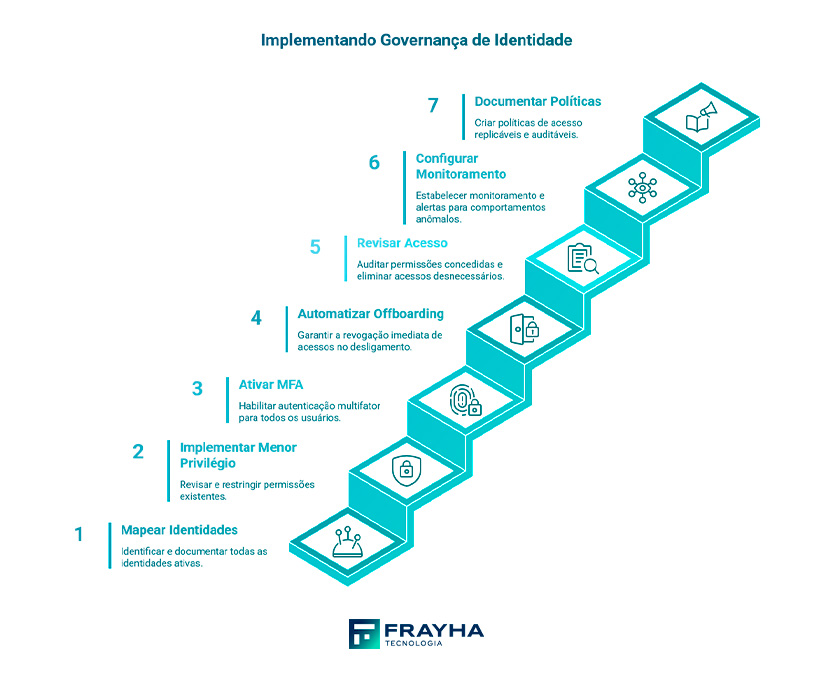
· Map identities;
· Implement Least Privilege actions;
· Activate MFA;
· Automate offboarding;
· Review access and permissions;
· Configure security monitoring and alerts;
· Document internal and external access policies.
These practices, however, require time, technical knowledge, and execution capacity that many internal teams simply don't have available on a daily basis, especially considering the operational pressure that analysts and IT coordinators face to keep systems running while the company's security posture still needs to evolve.
Well-executed identity governance protects the operation, enables compliance, and frees the IT team from the never-ending cycle of putting out fires.
However, putting all of this into practice requires more than tools, as it requires a partner that has a deep understanding of the Microsoft ecosystem, understand the peculiarities of each company's environment and learn how to translate technical configurations into understandable results for executive leadership.
A Frayha acts as a strategic partner in the implementation and management of identity solutions, making the most of the features already available in Microsoft 365 and Azure that your company may be underusing.
This includes everything from configuring Microsoft Entra ID, conditional access, and MFA, to structuring governance policies, automating access provisioning and revocation, and continuous monitoring of the identity environment.
In this sense, Frayha connects these two worlds, translating technology into business impact.
Request a free diagnosis and discover how your company can implement identity management with the support of those who already protect more than 1,300 users and manage more than 1,700 devices.

Learn when to hire IT consulting, the difference between reactive support and strategic maintenance, and the criteria for choosing the right partner.

Antivírus comum não basta mais. Veja como unir antivírus, firewall e IA para proteger sua empresa de verdade. Leia!

Learn the importance of cloud backup because the provider doesn't guarantee everything. Understand the real risk and what to do about it. Read on!

Schedule a conversation with our experts and discover how we can protect and boost your business, with no obligation.